

Have you ever wondered how a creature from 340 million years ago still influences our watery world today? Sea lampreys have a pretty amazing life story. They start off in shallow, pebble-filled pools, and over time, they transform into fish that attach themselves to larger swimmers. It's like watching a tiny fish grow into its own little water tale.
Today, let's take a closer look at these resilient creatures. Their journey shows us how nature can adapt in shifting aquatic homes, and their impact on the environment may just change the way you think about life under the waves.
Sea Lamprey Biology and Life Cycle
Sea lampreys have been gliding through our waters for more than 340 million years. They've seen it all and survived even the toughest challenges nature threw their way. Their life unfolds in three very different water homes, each setting the perfect stage for the next chapter. It all begins when adult lampreys swim to shallow pits near gravel riffles in late May or early June to lay their eggs. These spots are chosen carefully since they offer the ideal environment for the eggs to thrive.
Once the eggs hatch, tiny creatures called ammocoetes emerge. These little larvae burrow in soft, muddy sediment in slow-moving streams and spend three to seven years there. During this time, they gently absorb nutrients from the water, much like a sponge soaking up every drop, while slowly building the organs and body parts they’ll need later on.
After years as ammocoetes, these lampreys go through a big change, metamorphosis, that turns them into juveniles. This transformation is a bit like a tadpole growing into a frog. Once ready for a livelier life, they swim into larger bodies of water and adopt a parasitic lifestyle. In these vast waters, they attach to host fish with a suction-cup mouth armed with over 100 tiny hooked teeth, feeding on body fluids as they steadily grow.
In the end, after their feeding phase, they make their way back upstream to spawn one final time, completing the circle of life before their journey comes to an end.
Key life cycle phases:
- Laying eggs in shallow pits near gravel riffles
- Growing as ammocoetes in quiet, slow streams for 3–7 years
- Undergoing metamorphosis into juvenile lampreys
- Migrating to larger waters for parasitic feeding
- Returning upstream to spawn and finish their life cycle
Sea Lamprey Taxonomy and Identification
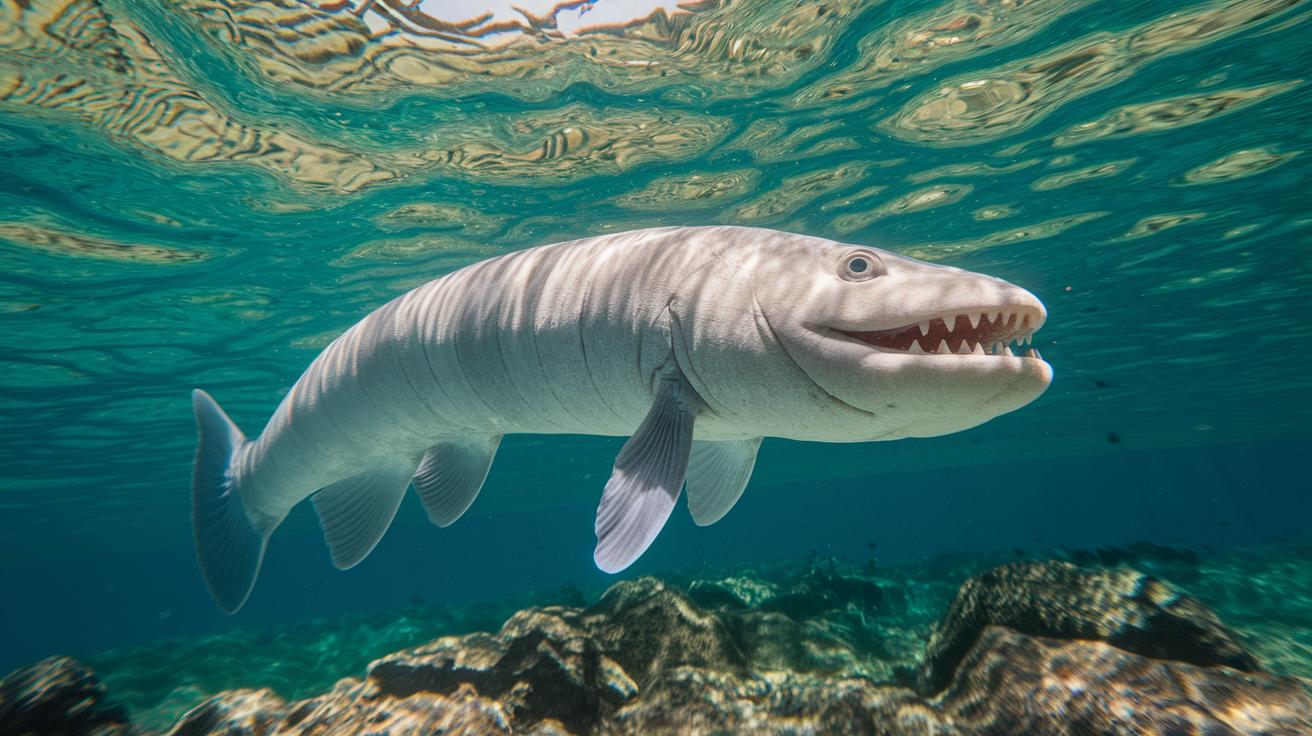
Sea lampreys are part of the Order Petromyzontiformes and belong to the Family Petromyzontidae, under the Genus Petromyzon. Their scientific name, Petromyzon marinus, tells us they are among the handful of jawless fish that have graced our waters for millions of years, making them a true living fossil.
You might picture a sea lamprey as something other than your everyday fish. Their smooth, cylindrical bodies lack scales, and their disc-like mouths, with over 100 tiny, hooked teeth arranged in neat circular rows, make them stand out. This unique mouth is perfectly designed for latching on to host fish, much like a well-adapted hook in a fishing line. Also, if you look closely, you'll notice their dorsal fin is deeply notched and seems to split into two parts, which adds to their distinct look.
Key features to help you spot a sea lamprey include:
- A smooth, cylindrical, scaleless body
- A disc-like mouth with over 100 hooked teeth arranged in circles
- A deeply notched dorsal fin that is split into two segments
These special traits make it easy for fish lovers and researchers alike to identify the sea lamprey and appreciate its unique place in our aquatic world.
Sea Lamprey Morphology and Physical Characteristics
| Characteristic | Details |
|---|---|
| Length | 30–76 cm (12–30 in) |
| Weight | 227–369 g (8–13 oz) |
| Color | Youth: silver with a dark back; Adult: olive-green with hints of brown/black |
The sea lamprey has a long, bendy body that looks like it was made just for a parasitic life. Its skin is smooth and rubbery because it doesn’t have any scales, which helps it wiggle into tight spots like a secret swimmer in the deep. It sports a split dorsal fin along its back, keeping it steady as it glides through water in search of its next host.
When the lamprey is young, it shows a light belly paired with a shimmering, dark top that can remind you of silvery or bluish shadows in water. As it grows into an adult, its color changes to an olive-green or almost black tone while the tummy stays light. This shift in color is like nature’s way of telling its life story.
Ever notice how every fish seems to have its own tale? With its suction-cup mouth lined with many little hooked teeth, the sea lamprey is perfectly built for clinging onto other fish. Each twist and turn of its body, every change in color, has been refined over millions of years to make sure it can find food and survive in all kinds of water worlds.
Sea Lamprey Feeding Behavior and Parasitic Mechanisms

The sea lamprey has a really unique way of feeding that's as fascinating as it is a bit intimidating. It uses a suction-cup mouth lined with over 100 hooked teeth arranged in neat, circular rows to latch onto unsuspecting fish. Its rasping tongue scrapes away at the flesh, much like a tiny saw working through soft material. Fun fact: one lamprey can consume up to 40 pounds of fish in its lifetime, leaving behind its very own signature bite marks.
Once it’s attached, the lamprey releases an enzyme that stops the fish's blood from clotting. In simple terms, this means the blood keeps flowing, giving the lamprey a steady supply of nutrients while it feeds. Although this method is efficient, it often leaves the injured fish with lasting scars, around 85% of them show clear bite marks, which helps researchers keep track of lamprey activity.
Key points about this feeding behavior include:
- Attaching with a suction-cup mouth and a rough, rasping tongue
- Using more than 100 hooked teeth to secure its grip
- Releasing an enzyme that prevents blood from clotting
- Possibly damaging up to 40 pounds of fish during its life
- Leaving behind bite wounds on nearly 85% of attacked fish
This feeding style, perfected over millions of years, is a striking example of nature’s clever adaptations. It not only helps the lamprey get the nutrients it needs but also marks its territory in the underwater world. Isn’t it amazing how nature crafts such effective, and sometimes destructive, strategies?
Sea Lamprey Habitat Distribution Patterns
Sea lampreys have always called many waters their home. Originally, they swam along the Atlantic coast, from Newfoundland all the way down to Florida, and they even made their way across parts of Europe, including the Baltic, western Mediterranean, and Adriatic seas. Their natural world is as diverse as a lively coral reef, mapped out by careful observation and simple mapping methods over many years.
It all started back in 1835 when these ancient fish were first spotted in Lake Ontario. Then, as the Welland Canal was improved during the late 1800s and early 1900s, new water routes opened up, allowing sea lampreys to move into Lakes Erie, Huron, Michigan, and Superior. Today, they live in the main parts and tributaries of all five Great Lakes, creating unique regional patterns that scientists keep an eye on using modern mapping tools.
Key milestones in their journey include:
- 1835: First spotted in Lake Ontario.
- Late 1800s to early 1900s: Canal improvements helped them spread quickly.
- Today: They are found in every one of the Great Lakes and are also native to the Delaware and Susquehanna River basins in Pennsylvania.
Researchers continue to track these movements closely, just like watching gentle ripples on a quiet pond, to understand both their history and their ongoing impact on our aquatic ecosystems.
Sea Lamprey Ecological Impact and Invasion History
When sea lampreys entered the Great Lakes, they really turned the fishing world upside down. Before these slim, parasitic fish appeared, locals were catching around 15 million pounds of lake trout every year. But soon after the lampreys arrived, things changed dramatically. By the early 1960s, the catch dropped to a tiny 300,000 pounds. It’s hard not to feel the ripple of this impact when you think about how it also hurt other fish like whitefish, burbot, and walleye.
Field studies from the 1940s and 1950s noticed that nearly 85% of the fish surviving lamprey attacks had bite marks or other injuries. Researchers kept track of these wounds to really understand how much these invaders were affecting fish health and local ecosystems. The changes were so vast that in 1955, officials set up the Great Lakes Fishery Commission to help manage the crisis and try to ease the burden on the lakes.
| Key Impact | Detail |
|---|---|
| Lake Trout Harvest Before Lampreys | Approximately 15 million pounds per year |
| Lake Trout Harvest After Lampreys | Roughly 300,000 pounds, just 2% of the original yield |
| Other Species Affected | Whitefish, burbot, and walleye populations declined |
| Fish Injuries | Up to 85% of surviving fish showed lamprey-caused wounds |
| Management Response | The Great Lakes Fishery Commission was formed in 1955 |
Sea Lamprey Control and Management Strategies
The Great Lakes Fishery Commission has cooked up some clever ways to keep sea lamprey numbers down. Their main method uses a chemical called TFM in smaller streams where lamprey larvae hide among the slow-moving sediments. Treating these tiny fish early means fewer can grow up to bother other species.
They also use physical barriers and traps as part of a team approach. By installing barriers in the streams, adult lampreys are stopped from swimming upstream to their spawning grounds. And any lamprey that manages to sneak by gets caught in traps, which means even fewer can finish their life cycle.
Since the 1990s, pheromone-based techniques have joined the effort. These natural chemical signals lure adult lampreys into areas where they can be treated or trapped before they cause more trouble. It’s a bit like guiding them gently with nature’s own cues.
All these methods work best when they join forces. The three main tricks include:
| Strategy | Description |
|---|---|
| TFM Lampricide | Targets young larvae in slow streams |
| Barriers and Traps | Blocks adult lampreys from reaching spawning areas |
| Pheromone Lures | Attracts lampreys into controlled, treatable zones |
Researchers continue to explore new biocontrol methods. These promise even safer and more focused ways to manage sea lamprey. Ever notice how a well-balanced aquarium uses a mix of natural methods to keep things thriving? That’s the spirit behind this effective approach.
Sea Lamprey Research Advances and Future Directions

In labs, scientists are imitating sea lamprey reproduction by using special spawning and rearing methods. They create small, shallow gravel-like settings to help lampreys lay their eggs, much like nature does. This setup lets researchers try out treatments and watch how the young lampreys grow and change, just like observing little fish dance in a clear stream.
Researchers also use computer models to predict how lampreys spread and how their numbers change. These models work a bit like a weather forecast for water, giving us clues about what might happen next. New tools help spot tiny lamprey larvae hiding in slow-moving streams, even when they’re tucked away among the sediments.
Looking ahead, planned research will focus on fine-tuning the natural scent signals that lampreys use and testing new chemicals that target the larvae. Scientists are also exploring improved biocontrol agents, natural ways to lower lamprey numbers without extra fuss. All this work, both in the lab and out in the field, brings us closer to smarter lamprey management with better prediction tools and more precise treatments.
Key research areas:
- Rearing lamprey larvae in the lab by mimicking natural spawning sites
- Using computer models to forecast shifts in lamprey populations
- Advancing monitoring tools to detect tiny larvae in slow streams
- Testing refined pheromone blends and new control chemicals
- Developing better biocontrol agents to naturally reduce lamprey numbers
Final Words
In the action, we explored the sea lamprey’s life stages, from spawning to adult migration, and examined its taxonomic identifiers and physical details. We shared insights on feeding behavior, habitat patterns, and its impact on local ecosystems. We even looked at control strategies and fresh research to manage these unique creatures. Each section offered a glimpse into how these aquatic wonders function and interact with their surroundings. Let these insights spark ideas and encourage continued passion for creating optimal aquatic environments.
FAQ
Q: Where are sea lampreys found?
A: Sea lampreys are found in their native Atlantic coastal waters and have invaded the Great Lakes, where they now occupy both main basins and nearby tributaries.
Q: What is the sea lamprey size?
A: The sea lamprey typically measures between 30 and 76 cm (12–30 in) in length and weighs around 227–369 g (8–13 oz), with size variations between juveniles and adults.
Q: What happens during a sea lamprey bite?
A: A sea lamprey bite involves attachment using a suction-cup mouth with hooked teeth, resulting in a painful wound often marked on the host’s body.
Q: How did sea lampreys get into the Great Lakes?
A: Sea lampreys entered the Great Lakes through man-made waterways like the Welland Canal, whose improvements during the late 1800s and early 1900s allowed their spread.
Q: Where are sea lampreys found in the Great Lakes?
A: In the Great Lakes, sea lampreys are found in both the main basins and surrounding tributaries, where they have become established over time.
Q: What is the sea lamprey scientific name?
A: The scientific name of the sea lamprey is Petromyzon marinus, which distinguishes it in the taxonomy of jawless fishes.
Q: How do sea lampreys reproduce?
A: Sea lampreys reproduce by migrating upstream to shallow gravel pits in late May to early June, where they spawn and then die after completing the reproductive cycle.
Q: What is included in the sea lamprey life cycle?
A: The sea lamprey life cycle includes spawning in shallow pits, a larval stage in stream sediments lasting 3–7 years, parasitic adult feeding, and post-spawning mortality.
Q: Are there still sea lampreys in the Great Lakes?
A: Sea lampreys remain present in the Great Lakes, thriving in both the main water bodies and their tributaries despite control efforts.
Q: Do lamprey bites hurt?
A: Lamprey bites hurt as they create wounds on their hosts, with many fish showing clear signs of attack and subsequent healing.
Q: What eats sea lampreys?
A: While some native predators may feed on sea lampreys, their control is largely managed by targeted human interventions rather than natural predation.
Q: Are sea lampreys aggressive?
A: Sea lampreys are not aggressive toward humans; their feeding behavior involves attaching to hosts for nutrients rather than deliberate, hostile attacks.